
Housing Association Tenant Benefits: From Cost Pressure to Long-Term Value

Housing associations have long been at the forefront of resident support in the UK. Well before resident engagement became a sector priority, organisations were already delivering hardship funds, financial inclusion services, and community investment programmes.
That foundation remains critical. But the operating environment is shifting rapidly.
Rising costs, new regulatory requirements, and increasing expectations around service quality mean housing associations must now deliver greater resident value with tighter financial headroom. Against this backdrop, tenant benefits are emerging as a strategic lever, not just a support tool.
The financial and regulatory pressure reshaping the sector
Analysis from the National Housing Federation highlights sustained cost pressures driven by inflation, rising repairs backlogs, and the scale of investment required to meet net zero targets and improve existing homes (National Housing Federation, 2025).
At the same time, the Regulator of Social Housing has strengthened its consumer standards, placing greater emphasis on tenant satisfaction, safety, and meaningful resident engagement through the introduction of Tenant Satisfaction Measures (Regulator of Social Housing, 2025).
Regulatory expectations are also increasing. Awaab’s Law, introduced through the Social Housing (Regulation) Act 2023, is now being implemented in phases, with initial requirements coming into force from 2025 and further measures expected to follow. The legislation requires landlords to investigate and resolve hazards such as damp and mould within defined timeframes, significantly increasing operational and compliance responsibilities (UK Government, 2025).
As a result, housing associations are operating in a more constrained financial environment, where rising costs and investment obligations are reducing financial headroom and limiting capacity for growth.
This creates a structural challenge: how can housing associations enhance resident experience and engagement while maintaining financial resilience?
What housing associations already deliver and why it is under strain
Across the UK, housing associations continue to provide essential support services, including:
Hardship and discretionary grants
Welfare, debt, and energy advice
Employment and skills programmes
Community investment initiatives
These services are vital. However, they are also reactive and resource-intensive.
The Centre for Social Justice (2025) highlights that demand for crisis support has increased significantly due to the ongoing cost of living pressures, with more households requiring direct financial intervention rather than preventative guidance.
This creates a cycle:
More residents fall into financial difficulty
Demand for support increases
Operational teams become stretched
Costs rise further
The challenge is no longer about commitment. It is about long-term sustainability and scalability.
From reactive intervention to preventative resident value
A growing number of housing providers are shifting focus towards preventative models of resident support.
Rather than waiting until financial stress escalates, the goal is to reduce cost pressure at source.
This is where tenant benefits play a strategic role.
UK households spend between £7,400 and £9,200 per year on essential costs excluding rent, including groceries, energy, transport, and broadband and mobile services.
For social housing residents, even modest savings across these categories can have a meaningful impact on financial resilience, particularly in a sustained cost-of-living environment.
Tenant benefit platforms enable residents to access discounts and savings on everyday spending, delivering:
Immediate financial relief
Reduced reliance on hardship funding
Improved perception of landlord support
Higher levels of ongoing resident engagement
Crucially, this support is passive and inclusive. It does not rely on applications, eligibility criteria, or case-by-case intervention.
Why resident engagement is now a regulatory and commercial priority
Resident engagement is no longer a “nice to have”. It is now central to both regulatory compliance and organisational performance.
The Tenant Satisfaction Measures (TSMs) introduced by the Regulator of Social Housing require providers to demonstrate performance across areas including:
Overall satisfaction
Perception of landlord service
Communication and engagement
Handling of complaints
Early TSM results published in 2025 show significant variation across the sector, with some providers reporting satisfaction scores below 70%, highlighting clear room for improvement (Regulator of Social Housing, 2025).
At the same time, research from Housemark (2025) indicates that higher resident engagement correlates strongly with lower arrears, fewer complaints, and improved tenancy sustainment.
This reframes engagement as both:
A compliance requirement
A driver of financial performance
Turning everyday spend into a new income stream
One of the most significant developments in tenant benefits is the ability to convert everyday resident spending into community reinvestment.
Traditionally, the £7,000+ spent annually by each household flows entirely to external retailers and service providers.
New models are changing that dynamic.
By embedding tenant benefits into the tenancy experience, housing associations can:
Provide residents with access to cost-saving discounts
Generate commission-based income from partner retailers
Reinvest that income into resident services and community initiatives
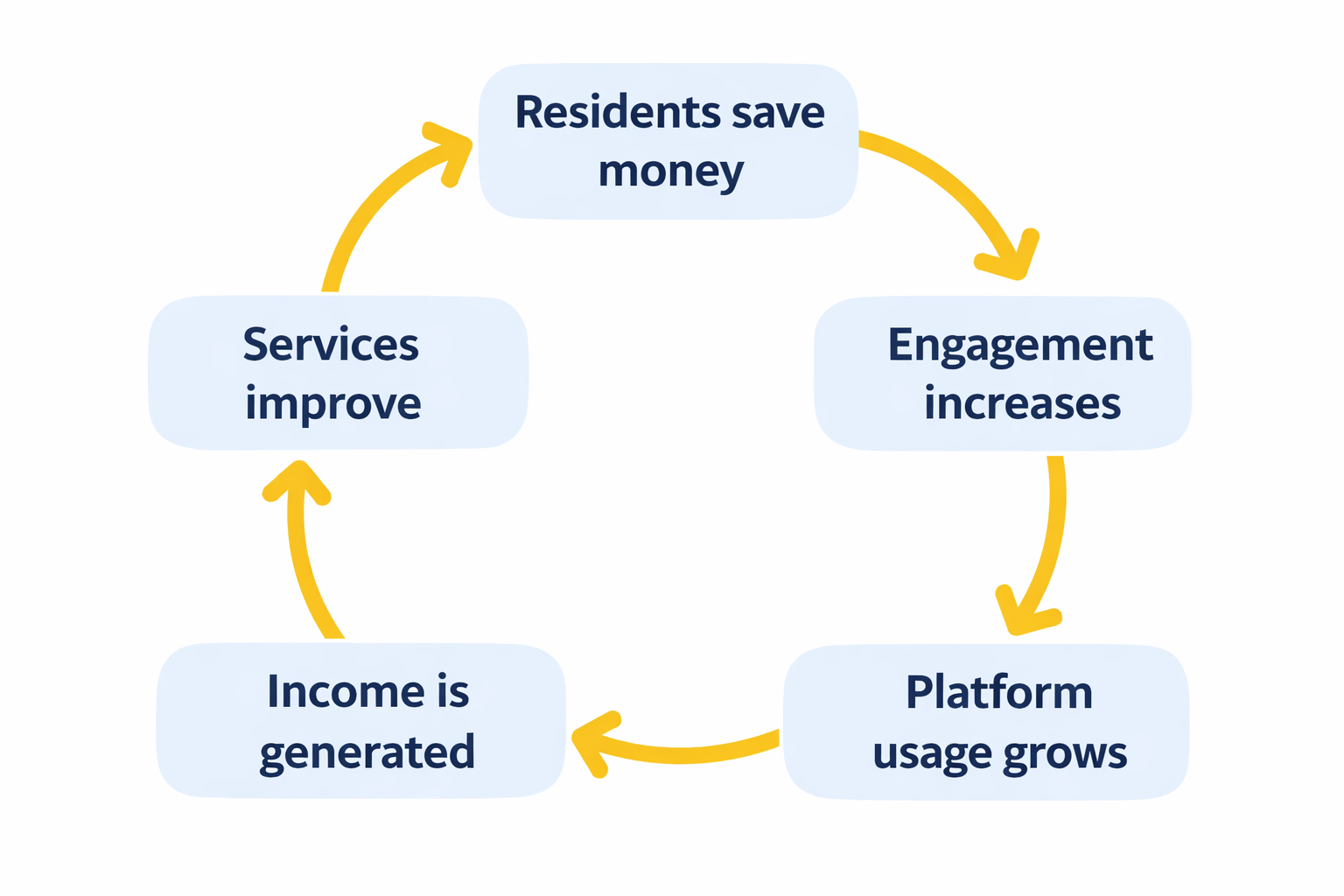
This creates a self-reinforcing value loop:
Residents save money → engagement increases → platform usage grows → income is generated → services improve
Rent Rewards is one example of this model, enabling housing associations to deliver tenant-wide benefits with no additional cost burden, while generating a new, non-rent income stream aligned to social value outcomes.
Importantly, this approach is built on data minimisation and privacy-first principles, ensuring resident trust is maintained, a critical factor as digital engagement increases.
Aligning tenant benefits with social value and fairness
For housing associations, how support is delivered is just as important as what is delivered.
The most effective tenant benefit models are:
Universal rather than selective
Easy to access, with no or low application barriers
Consistent across the portfolio
Designed to support financial wellbeing, not drive consumption
This ensures alignment with core sector principles:
Equity
Inclusion
Community impact
In the context of increasing scrutiny from regulators and residents alike, these factors are essential to maintaining credibility and trust.
Practical steps for housing associations
For teams considering tenant benefits as part of their resident engagement strategy, there are several practical considerations:
1. Start with outcomes, not features
Define what success looks like:
Reduced hardship demand?
Improved TSM scores?
Increased engagement levels?
2. Integrate into the tenancy journey
Benefits should not feel like an add-on. They should be:
Introduced at sign-up
Reinforced through ongoing communication
Embedded in digital resident portals
3. Measure impact consistently
Track:
Resident uptake and usage
Financial savings delivered
Correlation with arrears, complaints, and satisfaction
4. Protect trust through data responsibility
Ensure any platform aligns with:
GDPR principles
Data minimisation
Transparent communication with residents
Strengthening resident engagement without increasing rent
Housing associations are entering a period where doing more with less is not optional, it is structural.
Tenant benefits offer a way to:
Deliver immediate, tangible value to residents
Strengthen resident engagement and satisfaction
Reduce pressure on support services
Generate new income for reinvestment
All without increasing rent or adding operational complexity.
In a sector balancing financial resilience with social responsibility, that combination is increasingly powerful.
